
| Name | Field | Affiliation | Gabi Laske | surface wave seismology | IGPP/SIO | John Collins | body wave seismology | WHOI | Cecily Wolfe | body wave seismology | University of Hawaii | Dave Bercovici | geodynamics | Yale University | Erik Hauri | geochemistry | Carnegie Institute Washington | John Orcutt | seismology | IGPP/SIO | Bob Detrick | seismology | WHOI | Sean Solomon | seismology | Carnegie Institute Washington | Funding sources: NSF, SIO, DTM, WHOI |
 |
| Pu'u O'o in 1985 (borrowed from the HVO web site) |
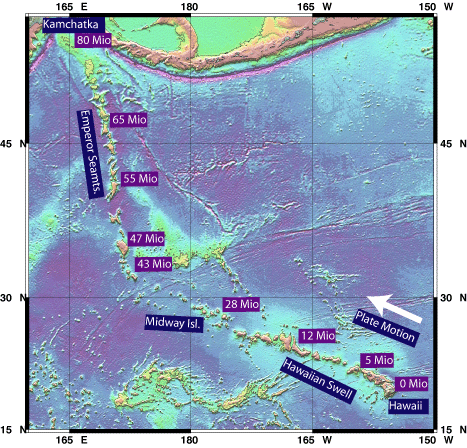 |
Most of Earth's volcanism is associated with activity near plate boundaries, either along mid-ocean ridges, or subduction zones. But there are prominent exceptions, so called isolated hotspots. The list of these vary among authors but there are thought to be some 46-70 hotspots. They can occur near plate boundaries (e.g. Iceland, Azores, Galapagos) but some are in the interior of plates (e.g. Yellowstone, Marquesas, Cape Verde), far away from any know plate boundary. Some of these are accompanied by long chains of islands whose age increases progressively, in the direction in which a plate is moving. The most prominent example of this is Hawaii. Its long Hawaii-Emperor seamount chain can be traced all the way to Kamchatka where the oldest seamount - a long extinct, now submarine volcano - is 80 Million years old. The chain has a pronounced kink indicating that something very significant happened in the Pacific about 40 Million years ago. There are other seamount chains in the Pacific and elsewhere, with similar age-progressions along the chain. The seamount chains in the Pacific appear to be aligned with the Hawaii-Emperor and some appear to have a similar kink. |
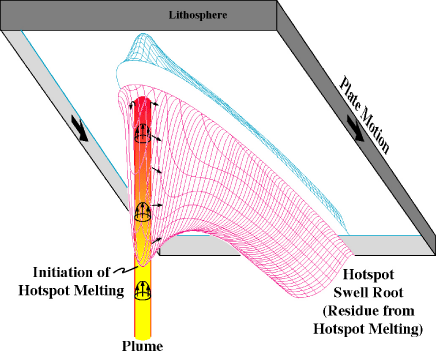 |
According to traditional thinking first proposed by Tuzo Wilson in 1965, hotspots are located above a stationary mantle plume. Through its about 100km wide conduit, magma is fed to surface volcanoes from deep inside the Earth. As a plate is moving above this stationary plume, volcanic activity dies out on a particular volcano and a new one is formed. The old extinct volcanoes subside progressively, forming a long chain of seamounts like the Hawaiian-Emperor chain. Jason Morgan proposed in 1970 that since many of these chains are aligned across the Pacific, the plumes seem stationary over long time. Their origin must therefore be deep inside the Earth, perhaps as far down as the CMB (core-mantle boundary), 2887 km below the surface. Hawaii is a very productive plume producing large amounts of magma and anomalous mantle material. This material is more buoyant than the regular mantle around it. The buoyant material therefore causes a pronounced uplift of the seafloor. Since the Pacific Plate is moving relatively quickly, the plate is dragging some of this material downstream. These processes manifests themselves in the almost 1000km wide and more than 1500km long Hawaiian Swell. |
 |
Earth material is very viscous but moves over geologic times. The Earth is convecting, a process which is often likened to a pot of water on a stove. Plate tectonics is the surface expression of a convecting Earth. Two forces drive mantle convection: differences in density of mantle material and heat. Through the first one, which is thought to be the dominant driving force, old oceanic plates are pulled into the mantle. In mid-ocean ridges and plumes, hot material is buoyant and ascends. There are two schools of thought where mantle plumes originate. While the material from mid-ocean ridges is thought to come from the upper mantle (the prominent 660km discontinuity separates the upper from the lower mantle), it is currently greatly debated whether slabs can penetrate into the lower mantle and whether plumes also originate in the lower mantle. Seismic tomography gives evidence for both. Evidence for layered convection comes from geochemistry. Plume basalts (a type of volcanic rock), or OIB (ocean island basalts), seem to be different from mid-ocean ridge basalts (MORB). It is thought that MORBs are recycled, depleted upper mantle while plumes tap fresh, primitive mantle from a different "reservoir". Different reservoirs inside the Earth could exist, if the Earth was not convecting as a whole but in two independent layers (upper/lower mantle two-layered convection). In such a system, plumes could originate somewhere near the 600km discontinuity. One the other hand, some geodynamical mantle convection models predict that sunken slab material could melt near the core mantle boundary, which could feed a mantle plume. In recent years, the plume hypothesis has been the subject of great debate. No single field in the geosciences can prove, or disprove, the validity of the plume hypothesis. Seismic tomography has yet been unable to conclusively image a single mantle plume from the CMB to the surface. In fact, plumes have been traced convincingly only into the lower reaches of the upper mantle. While the lack of evidence of plumes in the lower mantle could be real, there is a very good chance that the tomographic method fails in itself. The reason for this is that global tomographic methods have dealt with data sampling that is too sparse to image narrow plumes. Also, most tomographers use ray theory to interpret the seismic waveforms, an approximation that breaks down when anomalies become small (such as a 100km-wide plume conduit). On the other hand, most regional tomographic studies are unable to "see" into the lower mantle because the seismometer arrays are not wide enough. Not lastly, when analyzing the hotspot tracks in more detail, it now turns out that even the Pacific island chains don't seem to be consistent with the notion of fixed mantle plume. An alternative explanation for the island chains exists, at least in the Pacific. Due to stresses imposed by plate tectonics, existing weak zones in plates can propagate along which new volcanoes can form. If such a mechanism were predominant, seismic tomography should reveal no heterogeneity in the asthenosphere and below. |
 |
In its isolation from any plate boundary, the Hawaiian hotspot is the archetype hotspot. Its study is crucial to understand the dynamical processes inside the Earth. Yet, the seismic method has failed particularly badly to image the Hawaiian plume. Most past global tomographic studies have relied on just one permanent seismic station near Kipapa/Oahu (station KIP). Many tomographic images show a "red blob" near Hawaii, which would indicate the hot mantle from a plume. Also, this red blob can be traced down to significant depths. A problem with this is that the data from one station can be contaminated by instrumental and local effects. If not pre-conditioned properly, such data cause artifacts in the images of the deeper mantle. Even if the imaged anomaly is real, tomographers struggle to constrain the depth extent. Teleseismic body waves that are used in these studies have rays of near-vertical incidence and therefore smear anomalies over a large depth range. On the other hand, traditional regional studies using stations on land have greatly limited imaging capabilities. The islands line up along a chain making a 3D study nearly impossible. Also, even along the islands the profile is not very long, therefore not allowing us to image great depths. Not lastly, informed common sense tells us that the active plume conduit must be located to the south of Big Island, the place of current volcanic activity. This is well outside the reaches of our stations on the islands because of the uneven distribution of earthquakes along the rim of the Pacific. Regional surface wave tomography is also quite restricted in this case, as suitable earthquakes would have to lie along great-circle paths that share two stations. In addition, imaging capabilities using surface waves are restricted to the oceanic lithosphere-asthenosphere system. Surface waves are an excellent tool to search for the origin of the Hawaiian Swell relief but the current station distribution makes a useful study nearly impossible. The tomographic technique is not the only seismic method to constrain the origin of the Hawaiian plume. Attempts have been made through receiver functions, the analysis of body wave phases that convert to a different type when encountering a significant boundary such as the 660km. The transition zone between 410 and 660km that separates the upper from the lower mantle tends to be thinner when a hot plume intersects it, where the 660 domes upward and the 410 is depressed. Evidence of such a thinning has been found to the southwest of Big Island, a quite unlikely place when following the "informed common sense" idea. As exciting as these new results are, because they support a lower-mantle origin of the Hawaiian plume, they are controversial. For example, the area of the "common sense" presumed location of the plume conduit has never been mapped with this technique, due to the lack of suitable earthquakes. It is therefore difficult to define even the "baseline" transition zone near Hawaii. What is clearly needed here, is the deployment of a large array of seismometers around the Hawaiian island, which implies going to the ocean floor. |
 |
Two OBS deployments form the centerpiece of the PLUME experiment. The large number of required stations and the limited number of OBSIP instruments force us to stage our experiment in two deployments. The first array will be deployed in January 2005. Thirtythree stations are placed at a spacing of 75km around Big Island and roughly around the presumed location of the plume conduit. With the data of this year-long deployment we should finally be able to locate the conduit and image its shape and anomaly. From this, we can infer plume temperatures. A second, year-long deployment will be launched later, probably near the beginning of 2006. This array is wider, with a station spacing of about 200km. Seismic tomographic images will have less resolution capabilities but imaging can be performed to greater depth, possibly tracking the plume into the lower mantle. The wide array will also facilitate a detailed study of the Hawaiian Swell. The tomographic method is not the only one that we will use. Receiver functions are excellent tools to map discontinuities. With the PLUME deployment, we will fill crucial holes in the current data coverage. In particular, we will investigate the uniqueness and the extent of the curious thinning of the transition zone found to the southwest of Hawaii. Also of interest is the study of a shallow low-velocity zone (about 120km depth) that has been found beneath the islands. Mapping this zone gives clues about the temperature and melt content in the asthenosphere. Not lastly, the 3-component seismic records allow us to study shear-wave splitting and surface wave azimuthal anisotropy. A combined interpretation thereof allows us to constrain the fabric in the lithosphere and mantle flow in the asthenosphere. These will provide important clues on the dynamics of the Hawaiian plume. There is a suggestion that convection at the Hawaiian plume is more complicated than a parabolic pancake spread of dragged asthenosphere. Secondary convection that is perpendicular to the plate motion direction should be confirmed, or refuted, easily with our new dataset. In early 2010, the seismic data were made available at the IRIS-DMC to other researchers, after the standard PASSCAL 2-year proprietary-use limit was met. |
 |
Prior to the PLUME deployments, the long-term deployment of broad-band OBSs was not feasible. One reason
was that traditional OBSs were designed for short-duration deployment in active source experiments (using explosions or airguns as sources) to study the oceanic crust and uppermost mantle just beneath the Moho discontinuity. The limited battery life had not allowed long-duration deployments. Traditional OBSs also used short-period seismic sensors (1Hz, such as a Mark L4-3D) that could not record surface waves with high fidelity (20-120s, which are recorded by a Wielandt-Streckeisen STS-2). Advances in battery technology as well as the development of low-power consumption data acquisition systems and not lastly advances in sensor technology made, for the first time, year-long deployments of broad-band 3-component seismic instruments a reality. Not lastly, the national OBS Instrument Pool (OBSIP) that is funded by the National Science Foundation provided the opportunity, for the first time, to conduct large experiments that needed more than just a few passive seismic instruments. Such experiments could also, for the first time, be conducted by principal investigators that are not affiliated with traditional OBS facilities. The PLUME experiment was the third U.S. experiment that used the new OBSIP instruments, and the very first near Hawaii. Learn more about OBSIP at the official OBSIP website. |
Work Address: Gabi Laske
              IGPP-0225
              U.C. San Diego
              La Jolla, Ca 92093-0225

Office phone: (858) 534-8774
Fax:          (858) 534-5332
Email:        glaske@ucsd.edu